







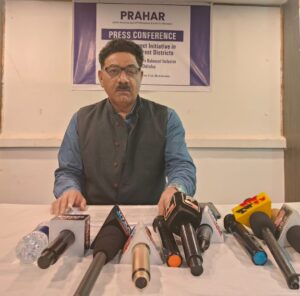

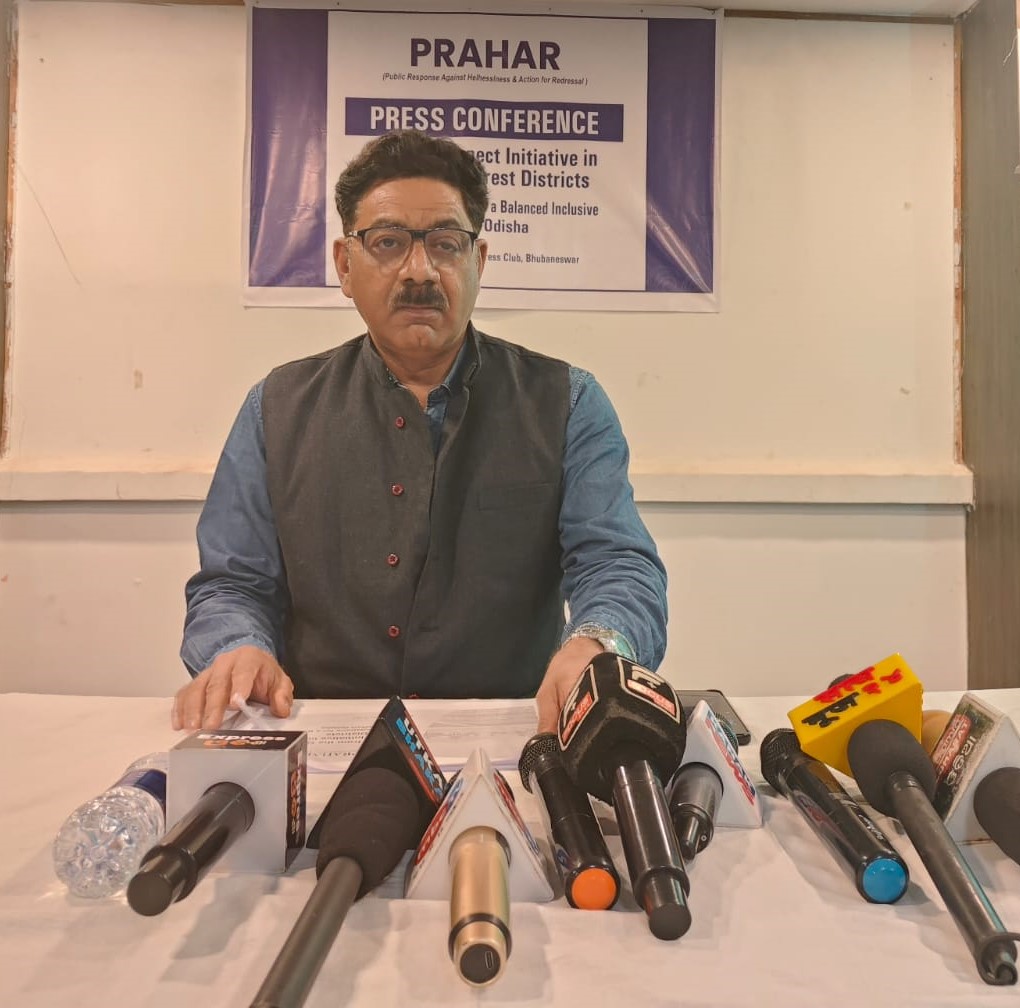
Bhubaneswar, swa news : PRAHAR – Public Response Against Helplessness and Action for Redressal, a policy-focused development organisation working on employment, livelihoods, and regional equitytodaypresented the findings of its Ground Connect Initiative in the KBK region comprising Kalahandi, Balangir, Koraput, Nuapada, Rayagada, Nabarangpur and adjoining areas, highlighting deep structural gaps in employment and livelihoods across Odisha’s poorest districts.
Based on extensive village-level fieldwork, community consultations and expert discussions, PRAHAR warned that while Coastal Odisha has emerged as the visible face of growth, large parts of Western and South-Western Odisha remain trapped in low incomes, distress migration and the absence of formal sector jobs.
Explaining the situation, Mr Abhay Raj Mishra, President & National Convenor, PRAHAR said, “Families in Western Odisha today rely heavily on migration to make their ends meet. People are leaving because there are no stable, formal jobs at home. Welfare schemes help families survive, but they do not create dignity, security or a future for the youth. There is an immediate need to re-think the developmental strategy and focus on fast-tracking projects which have high employment elasticity to reverse the trend”
“We are not asking the government to invent new ideas. We are asking to implement what is already approved. Jobs can be created nownot five years laterif stalled big ticket projects are unlocked now which are heavily invested and ready to operate.”, he added.
PRAHAR’s findings show that per capita income in districts like Kalahandi is around ₹32,000, compared to the state average of nearly ₹1.8 lakh, underscoring the scale of regional inequality. Agriculture continues to employ nearly 80% of the local workforce, mostly as marginal and seasonal workers, while non-farm employment options remain extremely limited.
According to PRAHAR, distress migration has become the default survival strategy, with non-official estimates suggesting up to 60,000 seasonal migrants from Kalahandi alone, and over 28.16 lakh migrant workers across Odisha. Recent reports of abuse and torture of migrant workers in Tamil Nadu have once again exposed the human cost of this employment deficit.
Jobs Are Possible—If Implementation Is Prioritised.
PRAHAR’s analysis highlights that the employment crisis in Western Odisha is not due to lack of projects or investment intent, but due to delays in implementation and under-utilisation of existing assets.
As per PRAHAR estimates, if due priority is given to implementation, it is possible to create nearly 35,000 jobs in Western Odisha, of which 25,000 jobs can be generated immediately within the current year itself, primarily by unlocking stalled industrial and mining-linked activities. Government has recently announced ₹4,111 crore worth of new projects which have the potential to create 9,924 jobs. However, these projects are expected to take four to five years to translate from announcements into actual employment on the ground. Several mining projects have already received approvals but remain stuck in implementation, and if these approved mining projects are operationalised, they can immediately generate 20,000–25,000 direct and indirect jobs, cutting distress migration sharply and reviving local economies.
MSME and Industrial Gaps
The Ground Connect Initiative found that Kalahandi has barely 200 MSMEs employing around 2,000 people, an average of just 10 jobs per unit, far below national and inter-state benchmarks. By comparison, MSME clusters in states like Gujarat and Andhra Pradesh generate several times higher employment density.
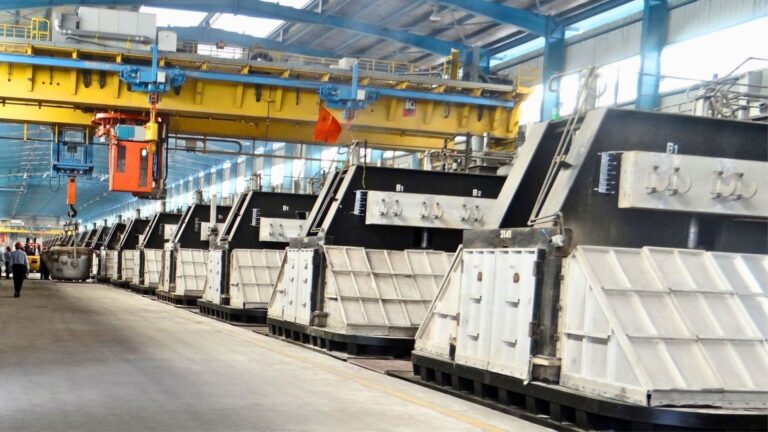
Despite Odisha holding one of the largest bauxite reserves in the country, new bauxite mining has remained stalled for nearly 25 years, leaving major aluminium plants underutilised and starving local economies of jobs, MSME opportunities and District Mineral Foundation (DMF) revenues.
Western Odisha is sitting on enormous natural wealth, but the people are not benefiting from it. A single operational bauxite mine can generate 500 to 1,000 direct jobs and three to four times that number indirectly. Today, that opportunity is locked underground.
PRAHAR further highlighted that Supreme Court-mandated local development provisions, including 5% of mining profits earmarked for affected communities, remain unrealised because mining has not commenced. Experts estimate that a fully developed aluminium value chain could generate ₹5,000 crore or more annually in royalties, DMF funds and associated revenues for the state.
Structural Imbalance in Development
The organisation pointed out that policy focus and investment momentum remain skewed towards Coastal Odisha, particularly steel-led growth corridors, while industrial ecosystems in Western Odisha have seen repeated delays. Even announced projects such as MSME parks in Kalahandi (Kesinga) have remained stalled since 2019.
Coastal growth is important, but not at the cost of abandoning an entire region. A Viksit Odisha cannot be built with one half moving forward and the other left behind.
PRAHAR emphasised that jobs must become the centrepiece of regional development policy. The organisation reiterated that large anchor industries, mining-linked MSMEs and aluminium downstream ecosystems offer the fastest pathway to employment creation in Western Odisha.
PRAHAR announced that it will submit a formal representation to the Chief Minister of Odisha, carrying the voices and demands of communities from Kalahandi and neighbouring districts, urging time-bound action to unlock stalled projects, fast-track industrialisation and create immediate employment.



+ There are no comments
Add yours